


%20(Lands.png)
%20(Lan.png)
READ THE ALBUM NOTES
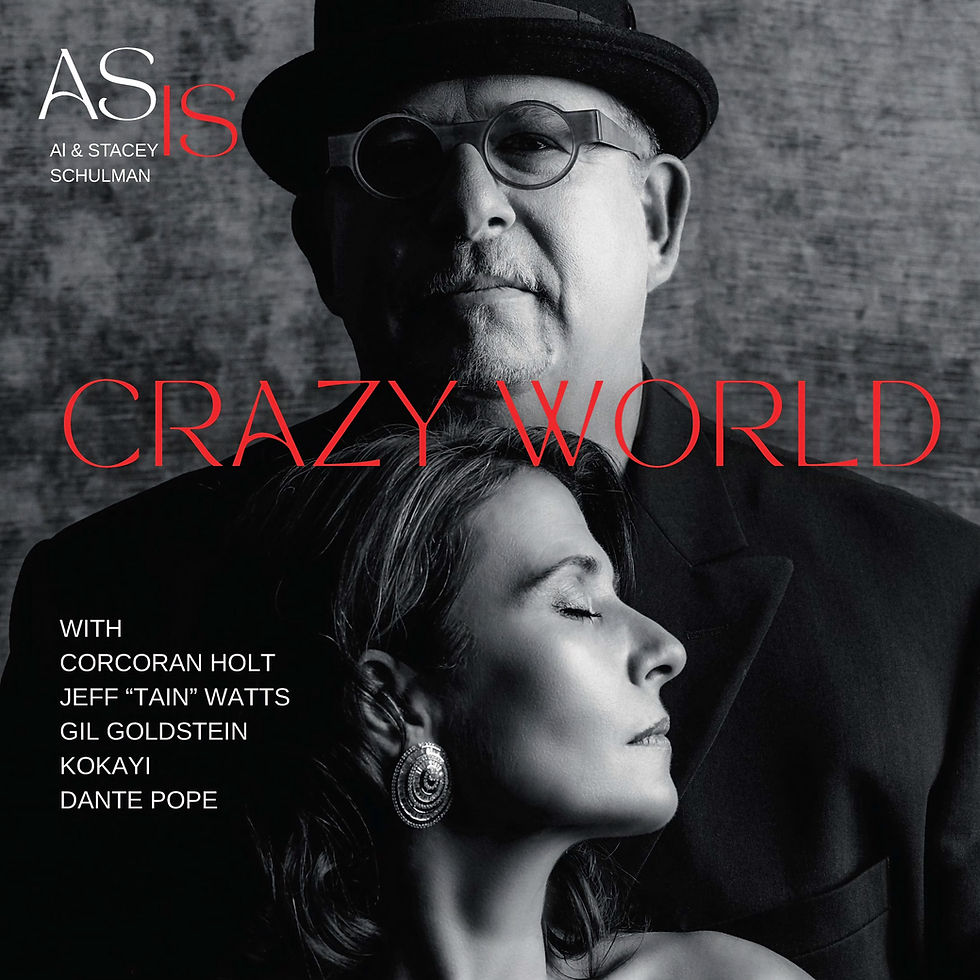
Crazy World – As Is
Album Notes by Keanna Faircloth
I’ve had the privilege of knowing As Is not just as listeners often do — through recordings — but through time. I first encountered their music in its earlier chapters and supported it on air at WPFW, and later at WBGO, watching their sound sharpen, stretch, and gain confidence with each release. What stands out most is not polish for its own sake, but growth, and a steady expansion of musical language, emotional reach, and artistic courage. Crazy World feels like the natural next chapter in that evolution.
Rather than centering As Is as a duo in the narrow sense, this album presents them as the nucleus of a larger, more ambitious musical vision. With a formidable rhythm section anchoring every track — Corcoran Holt on bass and Jeff “Tain” Watts on drums, with collaborators including Kokayi, Dante Pope, Gil Goldstein, and strings from the Curtis Institute, the music pushes beyond intimacy into scale. This is As Is stepping fully into the present tense: expansive, unafraid, and responsive to the moment we’re living in. The album’s title mirrors the times themselves: political uncertainty, cultural upheaval, technological anxiety, and the remarkable resilience that persists despite it all.
Every selection here carries an emotional charge that feels distinctly human. That humanity is central to “From This Moment On,” originally written as a romantic encounter but reframed here as pointed social commentary. Stacey Schulman delivers the lyric with clarity and purpose, while Alan Schulman’s guitar grounds the performance with steady resolve. Kokayi’s presence adds urgency, pushing the song into contemporary relevance. It’s a piece that dares to ask listeners to confront truth directly—something increasingly difficult in an era where communication is often reduced to screens, texts, and distance.
That emotional openness flows into “Better Than Anything,” which retains its playfulness while absorbing modern references without irony. By invoking today’s jazz artists alongside digital conveniences, the song gently questions what actually sustains us. Beneath the joy and lift of Corcoran’s bass line and Alan’s buoyant improvisation is an insistence that love, not efficiency or innovation, remains irreplaceable.
The album’s most disruptive statement arrives with “Prailude,” a work born from both curiosity and unease. Created using AI as a tool rather than a crutch, the piece confronts the growing threat artists feel from artificial perfection. Stacey wrote the lyrics while on a beach in Puerto Rico, singing parts into her phone as the idea took shape — a deeply human origin for a composition questioning the synthetic. AI here lacks the very things that define lived experience: authenticity, imperfection, risk. That tension is intentional, and “Prailude” is designed to unsettle, especially when placed beside what follows.
“Double Rainbow” answers that unease with breath and beauty. Drawing from Jobim’s melody, the track feels organic, imperfect, alive. Its sense of space and wonder is no accident. It represents the world AI cannot replicate, the physical and emotional texture that anchors us. The contrast between these two pieces is one of the album’s most powerful statements.
As Is continues to reinterpret familiar material with intention rather than novelty. “A House Is Not a Home” filters Bacharach and David through Northern Soul and Philadelphia Soul traditions, opening with a subtle nod to Barry White before layering emotional complexity through rhythmic restraint. Stacey’s scatting quotes Sting’s “Fragile,” reinforcing how easily love and stability, can fracture. The arrangement doesn’t soften the song’s message; it sharpens it.
Vulnerability deepens on “The Moon Is a Harsh Mistress,” where the trio format strips away excess. Space becomes part of the performance, allowing the ache and exposure of the lyric to land fully. It’s the kind of raw emotion that many younger listeners prefer to avoid, but As Is leans into it without compromise.
Their reimagining of “Tiny Dancer” further reflects artistic maturity. Rather than amplifying the song toward a crescendo, the arrangement pulls back into a pianissimo, choosing restraint over spectacle. The result is intimacy and a quiet confidence that comes from knowing when not to push.
A moment of pure musical instinct arrives with “As Falls Westphal,” named for the Drexel University Westphal School of Media Arts & Design, where the album was recorded under the guidance of producer and faculty member James McKinney. Fueled by a high-energy learning environment, faculty producing and engineering alongside student assistants, the track captures spontaneity and trust. Tain and Corcoran converse freely, creating space for reflection before forward motion resumes.
That momentum returns in the uptempo reprise of “From This Very Moment On,” reframing the album’s opening statement with renewed urgency. And finally, the title track “Crazy World,” originally sung by Julie Andrews in Victor/Victoria, delivers a quiet reckoning. Gil Goldstein’s accordion and arrangement, paired with strings, creates a cinematic close that is not despairing but grounded. It acknowledges chaos without surrendering to it.
In the end, Crazy World functions as both warning and reassurance. It asks us to consider what the future of music and society might look like if authenticity gives way to artificial ease. Yet it also offers hope through remembrance: of connection, of shared experience, of the power that emerges when artists and listeners meet honestly. Having watched As Is grow into this moment, it’s clear this album isn’t simply a reflection of the times, but a deliberate response to them. We are stronger and better, together.
Keanna Faircloth
Jazz Writer & Broadcaster
WBGO ~ WPFW ~ NPR



Who in the hell left the gate open?
FYC Information
Voting and Solicitation Guidelines
FYC communication. To opt out of future FYC communications from Open Gate Network, email Keanna@opengatenetwork.com.